
Queen Elizabeth National Park Uganda, Complete Guide 2026
Queen Elizabeth National Park is in southwestern Uganda, about 400 km (6–7 hours’ drive) from Kampala, between Lake George and Lake Edward. It covers about 1,978 square kilometres and is Uganda’s most visited national park.
It is famous for the Kazinga Channel boat cruise, the tree-climbing lions of Ishasha, chimpanzee tracking in Kyambura Gorge, and more than 95 mammal species and over 600 bird species.
The park stretches across the Albertine Rift Valley in Kasese, Rubirizi, Rukungiri and Kamwenge districts, with the Rwenzori Mountains on the northern horizon.
Its savannahs, wetlands, forests and volcanic crater lakes make it one of the most varied safari destinations in Africa. This guide covers its location, history, wildlife and top attractions. It also explains activities, the best time to visit, where to stay and how to get there.
Queen Elizabeth National Park at a Glance
| Fact | Details |
| Location | Southwestern Uganda, in the Albertine Rift Valley |
| Size | About 1,978 km² |
| Established | 1952, as Kazinga National Park; renamed in 1954 |
| Distance from Kampala | About 400 km, 6–7 hours by road |
| Wildlife | 95+ mammal species, 600+ bird species |
| Famous for | Kazinga Channel, tree-climbing lions, Kyambura chimpanzees, crater lakes |
| Main sectors | Mweya, Kasenyi, Ishasha, Kyambura, Maramagambo |
| Best time to visit | Dry seasons: June to September and December to February |
| Managed by | Uganda Wildlife Authority (UWA) |
Discover more in our facts about Queen Elizabeth National Park.
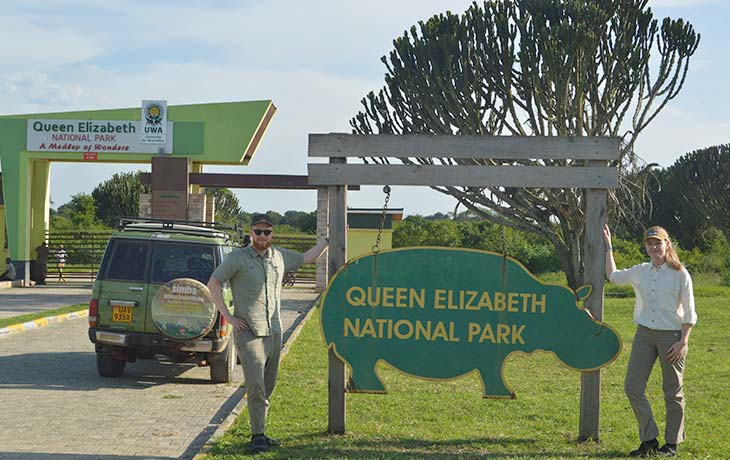
Where Is Queen Elizabeth National Park?
Queen Elizabeth National Park lies in western Uganda, on the floor of the Albertine Rift Valley. It sits between Lake George in the northeast and Lake Edward in the southwest, which are joined by the 32 km Kazinga Channel. The Equator runs through the north of the park, and the Rwenzori Mountains rise to the north.
The park borders Kibale Forest National Park to the north and the DR Congo’s Virunga National Park across Lake Edward. To the south it lies within easy reach of Bwindi Impenetrable National Park. That location makes it a natural stop between chimpanzee trekking in Kibale and gorilla trekking in Bwindi. See our destinations in Uganda guide.
A Brief History of Queen Elizabeth National Park
The park was created in 1952 as Kazinga National Park. It was renamed Queen Elizabeth National Park in 1954 to commemorate a visit by Queen Elizabeth II. During the 1970s and 1980s, poaching and political unrest badly reduced its wildlife.
Since then, the Uganda Wildlife Authority has rebuilt animal populations through anti-poaching patrols and community conservation, and the park is now part of a UNESCO Biosphere Reserve.
Geography and Ecosystems
Queen Elizabeth’s mix of habitats is the reason it has so much wildlife.
- Savannah grasslands:The open plains of Kasenyi and Ishasha, home to lions, elephants, buffaloes and Uganda kob.
- Tropical forest:Maramagambo Forest and Kyambura Gorge, home to chimpanzees, monkeys and forest birds.
- Lakes and wetlands:Lake George, Lake Edward and the Kazinga Channel, with large numbers of hippos, crocodiles and waterbirds.
- Volcanic crater lakes:The Katwe and Kasenda explosion craters, including salt-rich Lake Katwe and Lake Munyanyange.
Wildlife in Queen Elizabeth National Park
Queen Elizabeth is home to more than 95 mammal species, including four of the Big Five: lions, leopards, elephants and buffaloes. Rhinos are absent.
Mammals
- Lions:Including the famous tree-climbing lions of the Ishasha sector. Read about the sleepy lions of Queen Elizabeth National Park.
- Elephants:Large herds roam the savannahs and gather along the Kazinga Channel. See how much elephants weigh and what elephants eat.
- Leopards:Elusive predators best seen on night game drives in the Kasenyi plains.
- Hippos:Thousands live in the Kazinga Channel, one of the highest concentrations in Africa.
- Buffaloes:Large herds graze the plains and wallow in the channel.
- Antelopes:Uganda kob, waterbuck, topi, bushbuck and the rare sitatunga.
- Primates:Chimpanzees in Kyambura Gorge, plus black-and-white colobus, red-tailed monkeys, vervets and baboons.
Birdlife
With more than 600 bird species, Queen Elizabeth is one of Africa’s top birding destinations and an Important Bird Area. Highlights include:
- Shoebill stork, seen occasionally in the Ishasha wetlands and on Lake Edward. Hear the shoebill stork sound.
- African fish eagle
- Malachite and pied kingfishers
- Lesser flamingos, seasonally at Lake Munyanyange
- Grey crowned crane, Uganda’s national bird. Read about Uganda cranesand grey crowned crane symbolism.
See our guide to birdwatching hotspots in Uganda and waterfowl.
Top Attractions in Queen Elizabeth National Park
1. Kazinga Channel
The Kazinga Channel is a 32 km natural waterway linking Lake George and Lake Edward, and the park’s top attraction. A two-hour boat cruise brings you close to pods of hippos, basking Nile crocodiles, elephants and buffaloes drinking at the water’s edge, and hundreds of waterbirds.
2. Ishasha Sector and the Tree-Climbing Lions
The Ishasha sector in the remote south is famous for lions that rest in the branches of fig and acacia trees, a behaviour seen in very few places in the world. Ishasha is also home to elephants, buffaloes and large herds of Uganda kob, and is easy to combine with Bwindi. Read our full guide to the Ishasha sector.
3. Kyambura Gorge, the “Valley of Apes”
Kyambura Gorge is a sunken tropical forest about 100 metres deep, cutting through the savannah. It is home to a small community of habituated chimpanzees, as well as monkeys and forest birds. Guided chimpanzee tracking walks take place in the gorge each morning and afternoon. Learn more about chimpanzee families and facts about chimpanzees.
4. Mweya Peninsula
The Mweya Peninsula sits above the Kazinga Channel and Lake Edward, and is the park’s tourism hub. It has the main visitor centre, lodges and the launch point for boat cruises. Warthogs and banded mongooses often wander around the lodges.
5. Kasenyi Plains
The open Kasenyi savannah in the northeast is the park’s best area for morning game drives. Lions hunt among large herds of Uganda kob, and elephants and buffaloes are common.
6. Crater Lakes and Lake Katwe
The Katwe Explosion Craters drive takes you past dozens of volcanic craters with sweeping views of the rift valley.
- Lake Katwe:Where local people have mined salt by hand for centuries.
- Lake Munyanyange:A crater lake that attracts lesser flamingos in some seasons.
7. Maramagambo Forest and the Bat Cave
Maramagambo is a dense tropical forest in the south of the park, with primates, forest birds and crater lakes. Its famous Bat Cave holds thousands of fruit bats, along with the pythons that hunt them.
Things to Do in Queen Elizabeth National Park
1. Game Drives: Morning and late-afternoon game drives in Kasenyi and Ishasha offer the best chance of seeing lions, elephants, buffaloes and antelopes. Night game drives give you a chance to spot leopards, hyenas and other nocturnal animals. See what to expect from a safari in Uganda.
2. Kazinga Channel Boat Cruise: A two-hour cruise on the Kazinga Channel is the park’s signature activity, with close views of hippos, crocodiles, elephants and birds. Cruises usually run in the morning and afternoon from Mweya.
3. Chimpanzee Tracking in Kyambura Gorge: Walk with ranger guides into Kyambura Gorge to track its chimpanzees. Sightings are less certain than in Kibale Forest, but the gorge’s scenery makes the trek memorable. For the highest chimp sighting rates, combine your visit with Kibale Forest and see the best time to visit Kibale Forest.
4. Birdwatching: Birders can find 600+ species along the Kazinga Channel, in Maramagambo Forest, at Lake Munyanyange and in the Ishasha wetlands.
5. Cultural Encounters: Visit the salt miners of Lake Katwe, or enjoy traditional music and dance with communities around the park.
6. Nature Walks: Guided walks in Maramagambo Forest, around the Mweya Peninsula and along the crater rims let you explore the park on foot.
7. Lion Tracking Experience: Join researchers to locate and monitor lions using radio collars, on a limited-capacity experience in the Kasenyi plains.
Best Time to Visit Queen Elizabeth National Park
You can visit Queen Elizabeth National Park year-round, but the best time is during the dry seasons, from June to September and from December to February.
During these months, animals gather near water sources, vegetation is thinner and roads are easier to drive. The wet seasons, from March to May and from October to November, bring green scenery, newborn animals, excellent birding and fewer visitors. Read the best time to visit Rwanda and Uganda.
Where to Stay in Queen Elizabeth National Park
Queen Elizabeth offers lodges for every budget, from luxury lodges to simple campsites.
| Budget | Lodges |
| Luxury | Mweya Safari Lodge, Ishasha Wilderness Camp, Kyambura Gorge Lodge, Katara Lodge |
| Mid-range | Enganzi Game Lodge, Parkview Safari Lodge |
| Budget | Pumba Safari Cottages, The Bush Lodge |
| Camping | Designated campsites in Mweya and Ishasha |
Stay at Mweya or near Kasenyi for game drives and boat cruises, or in Ishasha if tree-climbing lions are your priority.
How to Get to Queen Elizabeth National Park
By Road:
- From Kampala:About 400 km, or 6–7 hours, via Mbarara or Fort Portal.
- From Kibale Forest (Fort Portal):About 2–3 hours.
- From Bwindi Impenetrable National Park:About 4–5 hours to Mweya, or 2–3 hours from Buhoma to Ishasha.
By Air:
Scheduled and charter flights run from Entebbe International Airport and Kajjansi Airfield to airstrips at Mweya, Kasese and Ishasha.
Conservation in Queen Elizabeth National Park
Queen Elizabeth faces threats from poaching, human-wildlife conflict and pressure from surrounding communities. The Uganda Wildlife Authority and its partners protect the park through:
- Anti-poaching patrolsthat remove snares and protect wildlife. Read about UWA’s fight against poaching.
- Revenue sharingthat returns part of park income to local communities.
- Research and monitoringof lions, elephants and other key species.
Every park visit helps fund this conservation work.
Why Visit Queen Elizabeth National Park?
Queen Elizabeth National Park combines classic savannah game viewing, one of Africa’s best boat safaris, chimpanzee tracking, tree-climbing lions and spectacular crater lakes in one park.
It is easy to combine with gorilla trekking in Bwindi and chimpanzee trekking in Kibale, which makes it the centrepiece of most Uganda safaris. Read is Queen Elizabeth National Park worth visiting?.\
FAQs: Queen Elizabeth National Park
Where is Queen Elizabeth National Park located? In southwestern Uganda, in the Albertine Rift Valley between Lake George and Lake Edward, about 400 km from Kampala.
What is Queen Elizabeth National Park famous for? The Kazinga Channel boat cruise, the tree-climbing lions of Ishasha, chimpanzees in Kyambura Gorge, its crater lakes and more than 600 bird species.
How big is Queen Elizabeth National Park? About 1,978 square kilometres.
Can you see the Big Five in Queen Elizabeth National Park? You can see four of the Big Five: lions, leopards, elephants and buffaloes. Rhinos are not found in the park. See our Big Five safari experience guide.
How many days do you need in Queen Elizabeth National Park? Two to three days is ideal for a game drive, the Kazinga Channel cruise, Kyambura Gorge and a visit to Ishasha.
How far is Queen Elizabeth National Park from Bwindi? About 2–3 hours from Ishasha to Buhoma, or 4–5 hours from Mweya to Bwindi.
Plan Your Queen Elizabeth National Park Safari
Queen Elizabeth National Park is one of Africa’s most rewarding safari destinations, with lions in trees, hippos in the thousands, chimpanzees in a hidden gorge and views of the Rwenzori Mountains. Combine it with gorillas in Bwindi and chimpanzees in Kibale for the ultimate Uganda safari.
Ready to go? Explore our Uganda safaris, current Uganda safari deals and best Uganda safari tours. You can also book the popular 5 Days Bwindi Gorillas and Queen Elizabeth Safari. Uganda Wildlife Tours will arrange your transport, park fees, activities and lodges, so you can simply enjoy the wildlife.